Wednesday, 28 October 2015
Saturday, 24 October 2015
Researching Institutions
I have researched a rang of film institutions to see what one I would use to produce, distribute and exhibit my film. An institution is an organisation or company, that produces and/or distributes media products.
From researching a variety of institutions, I am now able to decide who will produce and distribute my film. I believe all 5 of the institutions I looked at would be able to produce/distribute my film, however the institution I would choose is Lionsgate Gate. This is because I feel like they are a modern institution, who are already well respected within the film industry. I believe this is because of their success of understanding what their audience wants and being able to reach a large mass audience. They are also behind three of the most successful movie series (The Twilight Saga, The Hunger Games Triology and The Divergent Series). This shows they have a good relationship with their audience, as to make a collection of films they must all be equally as good and they obviously do this by knowing what their audience likes in films. They also focus in the British Horror Genre, which is the genre of my film. Their previous success will lead to a large advertising campaign, allowing my film to reach a mass audience.
Thursday, 15 October 2015
Audience Research
In my group’s audience research, I was in
charge of the film reviews. Hannah was in charge of the questionnaire and
Maisie was in charge of the focus group. As I was in charge of the film reviews
I decided to look at a variety of horror films from the distributer that I
chose for my film, Lionsgate. From looking at these film reviews I can see what
people of my target audience would like and not like to see, giving me the best
chance to make a film opening that my audience would enjoy.
SAW
-Many of the reviews discussed the film to
be ‘too gory’ and ‘too violent’. However, the main gist of the reviews was that
if you are an avid horror fan, you will most probably enjoy the film due to its
shocking twists and tense opening. This shows me that my opening needs to be
tense, to draw the audience in. Many of the film watchers also mentioned how
the film can be seen as ‘unrealistic due to the ceaseless violence and
excessive gore’.
MY BLOODY VALENTINE
-The overall consensus of reviews on My
Bloody Valentine was negative. This was mainly due to the ‘lame and
predictable’ storyline and the ‘easy plot to anticipate’. It was said to be
‘everything bad about slasher flicks’. However, some people did say that the
visuals hooked them in ‘with the twists, turns and shocks’. They also praised
the blood and gore part of the film. In my opinion these reviews show me that
Lionsgate horror fans prefer traditional slasher/horror films instead of
turning them into ‘flicks’ or comedies. Therefore in my opening I will not attempt
to use any comedy and keep it as close to a traditional horror film that I
can.
THE DEVIL'S REJECTS
-From looking at these reviews I have
learnt that most people who liked this film liked the development of
the characters and the story line. They believe the
film succeeded brilliantly at being 'sick, ruthless and grabbing you by
the throat'. The audience also mentioned how the story line was
unpredictable, which made the film exceed their expectations. Some reviews
mentioned how the 'fast pace opening' instantly engaged them and they was
'hooked from the start'. However, some over film-goers said that there was
a pointless amount of gore being used, and that characters where just
being set up for a 'violent, miserable death'. The over main negative point was
that they did not enjoy the 'attempted comedy'. Once again, I now know not
to use any attempted comedy and to make sure my opening is fast pace and
interesting.
From my audience research I have
found out that my audience like traditional horror films. This shows me
that I need to keep to the identifying traits of horror that I have previously
researched. I have also learnt that my opening needs to be fast pace, so
that the audience is immediately intrigued.
Tuesday, 13 October 2015
Moodboard
This is my mood board which I created to give me inspiration for my film opening.
I used various film posters, as usually a film poster will include an image of the scariest character/setting from the film, to not only scare the viewer but make them want to watch it. Knowing what the settings and characters look like in real life films helps me to picture what I want them to look like in my film opening.
I also used images of spooky settings, to give me ideas on how my film set should look. Most of the settings use dark lighting, and black and green colours.
I also included famous horror movie quotes.
To create the title of my mood board I used different horror fonts, to give me inspiration for the font and colour of writing I will use in my film opening.
Monday, 12 October 2015
9 Key Shot Screenshots of The Shining
TASK 11
The film starts off with a shot of picturesque scenery and a peaceful lake. This is an establishing wide shot. This is a key shot because it shows the audience where the film is set. It also relaxes the viewer from the beginning, contrasting to what they may have believed the film to start off with. However, although the setting looks peaceful we can also tell it is an isolated area. We can also tell it is part of a forest, which I previously found out was one of the traditional settings for a horror film. From this shot I know that isolated areas are an effective setting for a horror film.
The film opening I have chosen to annotate is The Shining, this is because it in the genre of horror.
The film starts off with a shot of picturesque scenery and a peaceful lake. This is an establishing wide shot. This is a key shot because it shows the audience where the film is set. It also relaxes the viewer from the beginning, contrasting to what they may have believed the film to start off with. However, although the setting looks peaceful we can also tell it is an isolated area. We can also tell it is part of a forest, which I previously found out was one of the traditional settings for a horror film. From this shot I know that isolated areas are an effective setting for a horror film.
Within seconds of the film beginning, the camera moves to strange angles. This shot is an establishing wide shot. This is a key shot because it is the first time the viewer witnesses the oddness of the film. This gives a distorted view which confuses the audience. The camera movement allows the idyllic view to quickly change to a confusing isolated area, where the viewer would most likely not want to be. This means that from the outset, the viewer feels that they don’t belong, causing them to be vulnerable to the film. This shot has shown me that distorted views will obscure the mind of the viewer.
After the viewer is giving a view of the isolated area, there is a shot of a car. This shot is a birds eye view. This is a key shot as it is the first time we see a sign of a character. As we have previously seen the inaccessible area, when we see the area a selection of questions are suddenly created in the viewer’s mind. We instantly start to think about why the driver is there, who they are and where they are going to. From this shot I know that mysterious images can engage the audience as they want to know what is happening.
There is then a shot of the road where the car will be driving. This is an asymmetrical shot. The image denotes a long, narrow and wide road. This is one of the traditional settings that I found out in my earlier research which potentially sets the scene and will portray to the viewer where some of the action will take place. The winding roads make the viewer feel nervous about the journey and we begin to think about who is around the corner. From this shot, I have found out that this this could potentially be built around suspension and uncertainty about will be about to happen. It could also denote to the viewer that some form of adventure or quest will take place.
This is a key shot because it includes the first credits of the film. This is an establishing wide shot which sets the scene of the action. The camera slowly pans in to a closer view of the car. This ensures the viewer that the character in the car may play a vital part in the film. As the camera gets closer to the car we feel like we are a part of the journey as well, which makes us feel as vulnerable as the characters in the car. In this shot the credits also begin to appear. They start scroll upwards and are aluminous blue in colour and in bold capital letters. From this shot I have learnt that making the viewer feel like they are a part of the film will make them vulnerable and more prone to be scared. I also know that the first credits should include the leading roles to interest the audience as they expect good acting in the film.
The credits begin with the two main characters, then the title of the film, then the rest of the characters and producers. This is a key shot as we learn the name of the film and names of the main characters and producers. This shot is called an establishing wide shot. When the title of the film appears, it scrolls upwards slower than the previous credits. This is so that the audience remembers the name of the film. When reading the credits, the view of the car driving is still in shot. As we are reading the credits, it prolongs the length of the journey as we forget it is there. From this shot I have learnt it is important to have the name of your film and the leading actor’s name included in your initial credits, so that the audience are excited about the level of acting they are about to watch.
As the shot of the car zooms out again, we see a typical horror setting. This is an establishing wide shot. Even though the car is very small in this shot, it shows the car going into the unknown.The view is of a snowy, mountainous location, which is still isolated. This view is quite a drastic change to the beginning view, even though they are both seen as traditional horror settings. From this shot I have learnt that making your character go to an unknown location can intrigue the audience, as they want to know where the character will go.
In this shot we see the first view of a building. This is an extreme long shot. The building is completely isolated from any type of shop or city. This makes the viewer concerned, as they know that if something bad happens no help will be easily accessible. In the distant there is a large, snowy mountain which looks like a holiday destination. From this shot I have learnt that the action will take place in the wilderness in a winter setting as you can see the snowy mountains and lush green forests.
The last shot of the opening scene is of a close up view of the hotel. This is an establishing wide-shot. It looks grainy and dull and not somewhere that the viewer would want to stay. The structure of the hotel looks like a prison, which makes the audience instantly associate the hotel with violence and criminal activity. Although there are a few cars outside the hotel, it looks totally inaccessible. This is a key shot because it I the closest view of the hotel, which is the main location, that we have in the film opening. From this shot I learnt that the film opening should have some sort of cliff hanger to create enigma, for example ending the opening on a shot of the hotel intrigues the viewer on what will happen in the scary looking hotel.
Thursday, 8 October 2015
Textual Analysis for the Ring Two
Textual Analysis
I chose the
film the Ring Two, because it fits within the horror genre and conforms to the conventions
which we will be using.
Camera shots and angles
The opening
scenes begins with a birds-eye view of waves crashing together in the ocean. A
birds-eye view is used to show the viewer the landscape and making slight
subtle references to key scenes that will happen later in the film. It gives
the audience a feeling of control as they are in charge looking down and gives
the audience a slight perspective and view of what could potentially happen
within the scene. There are multiple birds-eye views, before it cuts into an establishing
wide shot. Establishing wide shots are used to show the audience where the
scene and action will take place, with a detailed view of the location. By
using an establishing wide shot, the viewer can make initial judgements on the
location of the film. The first establishing wide shot then cuts into another
one, showing the viewers a spooky looking house. This makes the audience aware
of where the action will take place and immediately warns them that the house
will encounter scary and eerie events.
Lighting
From the
outset, low key lightning is used. The waves that are in shot are dark. Low key
lightning is used to create mood and set the tone of the scene, usually
associated with horror films. It can be used to create suspense within the
scene or control what the viewers look at and how much of the surrounding scene
they can see. This can leave the audience feeling vulnerable as the dark can be associated with the unknown and fear.
The
lighting in the house where the two teenagers are sitting is low key, which is
stereotypical of a house in a horror film. This also conforms to the conventions in a slasher/horror film. The low key lighting in the house creates an eerie atmosphere and gives the impression that an act of horror is about to happen.
Editing
The opening scene starts with multiple shots of waves crashing against each other. Each shot lasts about 3 seconds and then cuts to a black frame to a different shot of an ocean. Throughout each shot, the exhilaration of the waves slows down going from extremely violent to calm. The fast pace changing of the shots gives the audience the idea of speeding up time, meaning they are getting closer to the main horror event. By the film opening with a range of shots of the ocean, we learn that that location may be a key part of the story later on. Another shot used is the fade in from the establishing wide shot of the town, to the shot of the house. This fade has been used to quickly give the viewer a good idea of where the film takes place. The fade in is quite a calm, slow transition which may allow the viewer to remain calm. By creating a calm atmosphere for the audience, they are more likely to be defenceless against the upcoming part of the film which will make them jump.
Sound
The opening begins with loud, dramatic non diegetic music which comes to an abrupt end when the first shot of the waves appears. The dramatic music then begins again, with the noise of the waves on top of it. The music is tense, slow and mysterious, creating enigma within the opening. The music does not match the shots of the calm wave, which creates disorientation within the audience. The music comes to a sudden end with the diegetic sound of the boy whispering 'HEY' into the girls ear. The whisper frightens the audience as it is loud and unexpected. Quiet music then appears when the girl and boy have a conversation. This adds tension to the scene. The loud sound of the door squeaking is a traditional noise in horror films, and makes the audience want to know what is behind the door. There is then a loud sound made when the boy realises what the time is, giving us the understanding that the boy is against time. The music then once again sounds tense when shot then changes to the girl putting the VCR into the player, the audience is now wondering why the VCR is so important. When the VCR starts up, a loud static noise sounds, making the audience jump which is a key convention in horror. The opening scene ends with a variety of unsettling diegetic sounds including the ringing of the phone, beeping of the oven and clicking of the timer. All these noises make the viewer feel agitated meaning they are more vulnerable to being scared.
Mise en
scene
The mis en scene is everything that is a part of the scene, including costume, make-up and props. Both the characters are wearing casual clothes. This makes it easier for the audience to relate to the characters as they look like ordinary people, allowing the viewer to believe the act of horror can happen to anyone, even the audience. The interior of the house is quite old-fashioned, with patterned furnisher and a large television. Within seconds of being in the house, the main focus becomes the VHS. The body language shown by the boys shows that he feels anxious and impatient. He tries to force the girl into watching the film, by persuading her that it is a must see film. We can see that the girl is worried by how the boy is acting, as she doesn't feel comfortable watching the film on her own.
Settings
and Locations
The opening starts with the locations of different oceans. These locations can be seen as a calm setting, which contrasts with the dramatic music that is playing. The first setting we see is of a town in the dark, we then see a shot of a house which we learn to understand is the main location for the opening. The setting is in the front room of the house we are shown. This allows the audience to relate to the film more, as the event of horror could happen to them sitting in their own living room.
Narrative
The Ring Two is an open narrative, as it is carrying on from the first film. This can make the audience believe that horror events from the first film are ongoing and never ending. Props theory can be seen in the opening, by there being clear typical characters from his theory. The boy can be seen as a sinister helper, as he is showing the girl the film, even though he knows what will happen to her. This could mean he is a helper because he is helping The Ring complete what they want. The girl can be seen as a princess, who is young pretty and vulnerable and trusts what the boy tells her. As well as the characters being typical of Propps theory, a young boy and girl in an empty house watching a scary film is also a typical convention of a horror story. Because of their age, they will be curious of experiencing new emotions, scared being one of them. This could lead them to doing what they should not in an event of horror, for example going to investigate a spooky noise instead of getting ready to defend themselves.
Saturday, 3 October 2015
Traits, codes and conventions of Horror Genre
I have researched the key conventions of horror films, to
give myself an understanding of what I need to include in my film opening. I
researched the three codes; written symbolic and technical.
Traditional traits of horror
SYMBOLIC CODES
Symbolic codes is the way in which objects have been used to create an atmosphere. This includes props, costumes, colour and body/facial expressions.
The victim can be seen in normal clothes, to show that the horror event could happen to anyone. In addition, the villain of the film will usually be in dark outfits, which are mysterious and fit in with the setting. For example, if the setting is a dark forest and the villain is wearing a dark costume, it becomes even harder for the victim to defend for themselves.
Makeup used in horror films is usually used for dramatic effect. This includes putting makeup on the actor to recreate gruesome cuts and gory injuries. When done correctly, this is an effective way to make the characters wounds look realistic, which makes the audience believe the incident they were in. If the story is more believable it will make it a lot scarier for the audience.
WRITTEN CODES
Traditional traits of horror
-Characters don’t think about danger
-Power and phone lines are cut
-Someone investigates a strange noise
-Vehicles don’t start
- Warnings are ignored
-Bad weather conditions
TECHNICAL
CODES
Technical codes include the ways that equipment has been used in the film, for example camera-work, lighting, sound and special effects.
In horror films, pans are used to show the character
realising something is wrong. The pan would start with incident and then move
onto the character, showing their reaction when they realise they are in
trouble.
Fast pace editing is used to create suspense. This is because
a lot is show in a short amount of time, which can overwhelm the viewer and
confuse them. It also gives the impression of time passing quickly which can increase
the viewer’s heartbeat and anxiety, meaning they will be frightened easily.
In a horror film, the facial expressions of the characters
are extremely important. The audience needs to know if someone is
frightened/worried, so that they also begin to feel panicked. Because of this,
close up shots are used so the viewer can easily relate to the characters
feelings.
Traditional horror films use low key lightning to frighten
the audience. This is because you can’t see what is in front of you in the dark,
so there is a feeling of unknowingness. It is also harder to defend yourself in
the dark, meaning that the character is seen as vulnerable. However,
spotlighting can be used, to focus the audience on a certain part of the scene.
In horror this could be the characters reaction, or the frightening event that
is taking place.
One of the most important technical codes in horror is sound.
This is because sound is the easiest way to instantly create an atmosphere. The
music used in the scene can emphasis the emotions of the character. It is also
stereotypical of music in a horror film to start slowly and quietly and
gradually get quicker and louder. This creates enigma as the viewer knows that
usually at the end of the high tension music, something bad is about to happen.
Specific sounds can also be loudened, so more emphasis is created on the object
making the sound, for example a squeaking door handle, a window slamming shut
or footsteps.
SYMBOLIC CODES
Symbolic codes is the way in which objects have been used to create an atmosphere. This includes props, costumes, colour and body/facial expressions.
The setting for horror films is usually in a secluded area.
Abandoned areas are used so that there is no one around to help the characters
who are in danger. Dark eerie places are used, as they are gloomy, mysterious
places, where the viewer would not want to be themselves. Haunted houses are
also used a lot in horror films. The haunted houses include large spiralling
staircases, large empty rooms, and wooden squeaky floorboards and are usually
placed in an isolated area, such as the middle of a forest. Typical horror
settings include, haunted houses, cemeteries, forests
Prop used in horror films would
include items such as weapons, knife and old fashioned objects. The props will
be associated with the subgenre of the horror film. For example, a thriller
horror could include knifes and masks, whereas a traditional horror film could
include an antique rocking chair and an old doll. The props help set the scene
not only by what they are but also the quantity and spacing. For example if
there was a lot of props the viewer may feel overwhelmed, whereas if there was
minimal props spaced out the viewer may feel spaced out and more aware of the
setting.
The victim can be seen in normal clothes, to show that the horror event could happen to anyone. In addition, the villain of the film will usually be in dark outfits, which are mysterious and fit in with the setting. For example, if the setting is a dark forest and the villain is wearing a dark costume, it becomes even harder for the victim to defend for themselves.
In a horror film, dark eerie
colours are usually used, for example green, brown, and black. This is because
it creates a sinister setting as the colours are gloomy and frightening.
Colours can be seen in the setting, on objects and on text.
Makeup used in horror films is usually used for dramatic effect. This includes putting makeup on the actor to recreate gruesome cuts and gory injuries. When done correctly, this is an effective way to make the characters wounds look realistic, which makes the audience believe the incident they were in. If the story is more believable it will make it a lot scarier for the audience.
WRITTEN CODES
Written codes include the types of font on the screen, the
language and vocabulary spoken or seen and any subtitles/ credits.
The fonts used in a horror film are
traditionally ghostly and spiky. They may have slanted serifs, and the letters
may seem distorted to confuse the viewer. The fonts will be used to write the
credits and title of the film. The colour and font of the credits will usually
match the title so that it matches. The colours of fonts are usually darks
reds, blacks and green, however some are white so can be easily read on the low
key lighting scenes.
In a horror film the language and vocabulary will be spoken in different tones depending on the characters situation. For example the victim of the scene will speak quietly and worried, whereas the villain will talk in an angry and dominating voice, which will scare the audience.
Thursday, 1 October 2015
Preliminary Task
180-degree rule
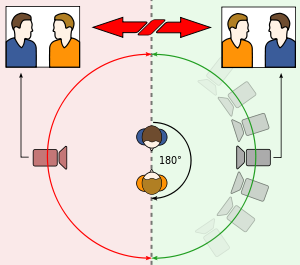
I learnt that the 180 degree rule is where the filming only takes place within the 180 degree angle where the converstaion is taking place. This ensures that the characters maintain the same left/right relationship to each other, meaning the characters will not get confused and be able to follow the film.
Match on Action
I learnt that a match on action shot is an editing technique that cuts from one shot to another shot, portraying the action that has taken place in the first shot. It uses two connecting shots, where the character finishes off their action from the first shot, in the second shot. This creates a continuous flow in the scene.
Shot Reverse Shot
I learnt that a shot reverse shot is used when two characters are looking at each other or the objects. It can be used in conversations, along with the 180 degree rule. It is split into two shots. The first shot is of the first character showing exactly where they are looking, this can be done by using over the shoulder or point of view. It will then cut into a second shot of the second character in the reverse position. There many also be a shot at the and of both characters/object looking at each other to show where they are.

Here is my groups end preliminary task.
Subscribe to:
Comments (Atom)